Our largest variable cost is not labour and it is not utilities
Independent hotels sent 63.4 percent of their bookings through online travel agencies last year. At the commissions those channels charge, distribution is the biggest single line standing between a full hotel and a profitable one.
Prash PatilAugust 26, 2026 · 6 min read
Ask an owner what their biggest controllable cost is and most will say labour. In California that answer is defensible. It is also, for a lot of independent properties, wrong.
The Cloudbeds 2026 State of Independent Hotels Report, compiled from roughly 90 million bookings across more than 180 countries, found that online travel agencies accounted for 63.4 percent of independent hotel bookings in 2025, with some markets approaching 80 percent.
At the commissions those channels charge, that is not a marketing expense. It is the single largest variable cost in the building, and unlike labour it produces nothing the guest can see.
The same room, sold two ways
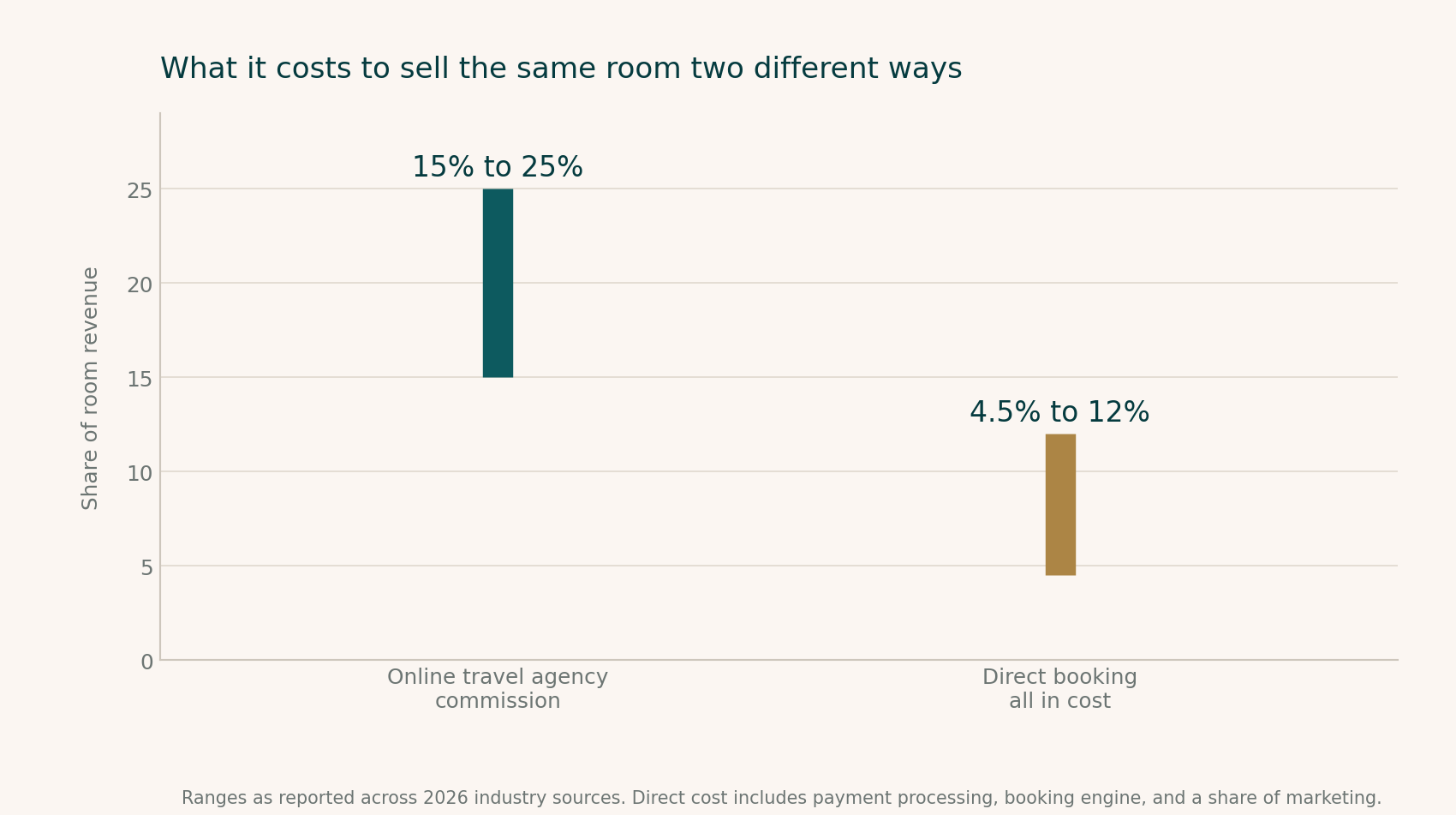
Commission on an independent property generally runs 15 to 25 percent of room revenue depending on the platform, the market, and whether you have bought into a preferred or sponsored placement programme. Add-on programmes and advertising push the effective number higher.
A direct booking is not free. Payment processing, a booking engine, and a share of marketing all cost something, and industry estimates for the all-in cost of a direct booking sit somewhere between roughly 4.5 and 12 percent depending on how honestly you load the marketing in.
Ranges as reported across 2026 industry sources. The honest version of
the direct number includes processing, the booking engine, and
marketing, not just the absence of a commission line.
The gap is the whole argument. Not that one channel is free and the other is not, but that the same room night, at the same rate, to a guest who would have come anyway, nets you materially less through one door than the other.
What that looks like at our size
Most writing on this subject uses a hundred room property, which makes the numbers dramatic and the lesson unusable for anyone running thirty. So here is the arithmetic at a scale that actually resembles a small independent.
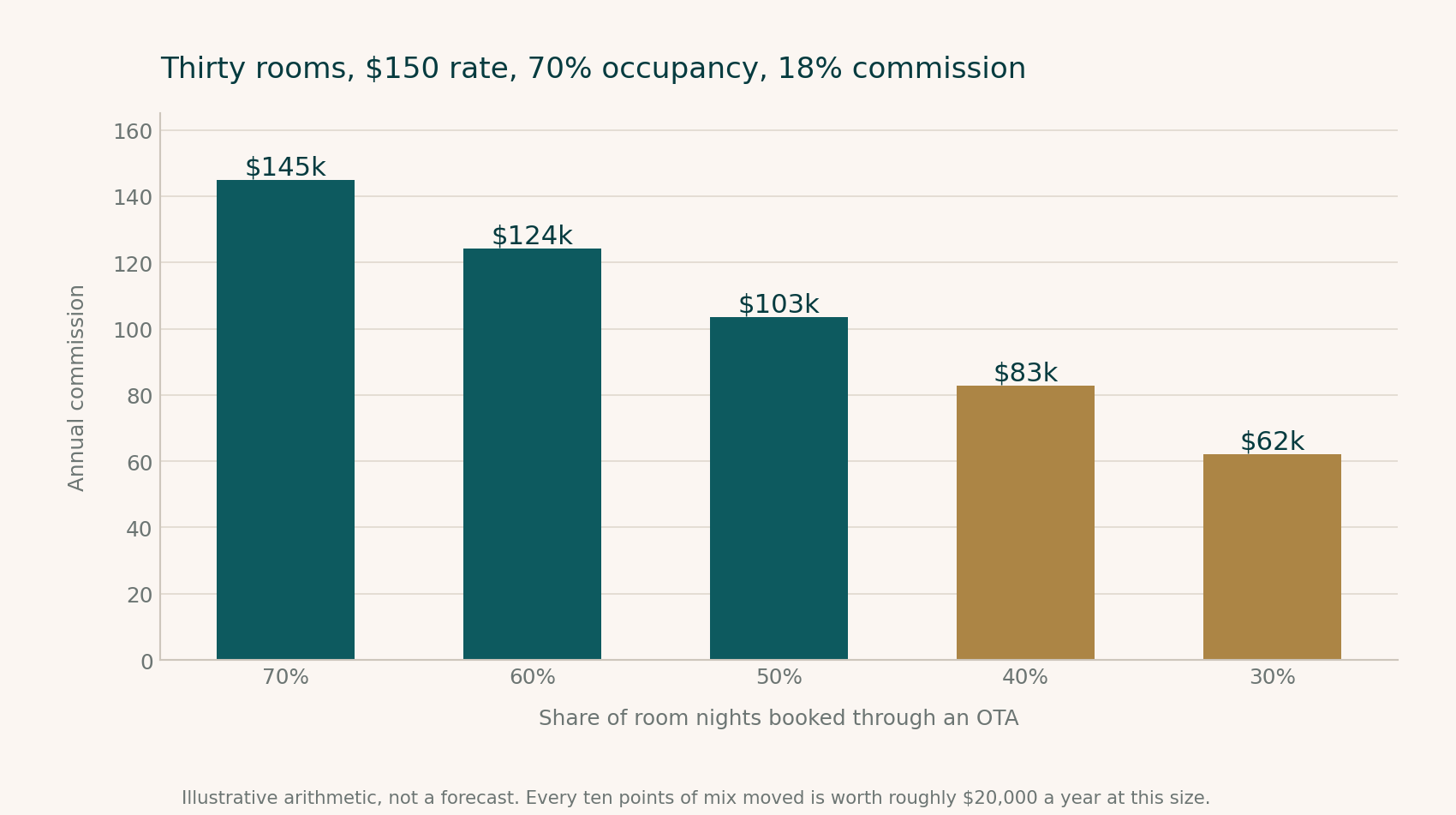
Thirty rooms, a $150 average rate, 70 percent annual occupancy, 18 percent commission. That produces roughly $1.15 million of room revenue.
Illustrative arithmetic, not a forecast and not our figures. Every ten
points of channel mix moved is worth roughly twenty thousand dollars a
year at this size.
Twenty thousand dollars a year, for ten points of mix. That is a roof repair. It is a full room renovation. At a small property it is the difference between deferring something and doing it.
And it compounds, because the properties sitting at 70 percent OTA share are usually the ones with the least pricing power to begin with.
The part that is not the commission
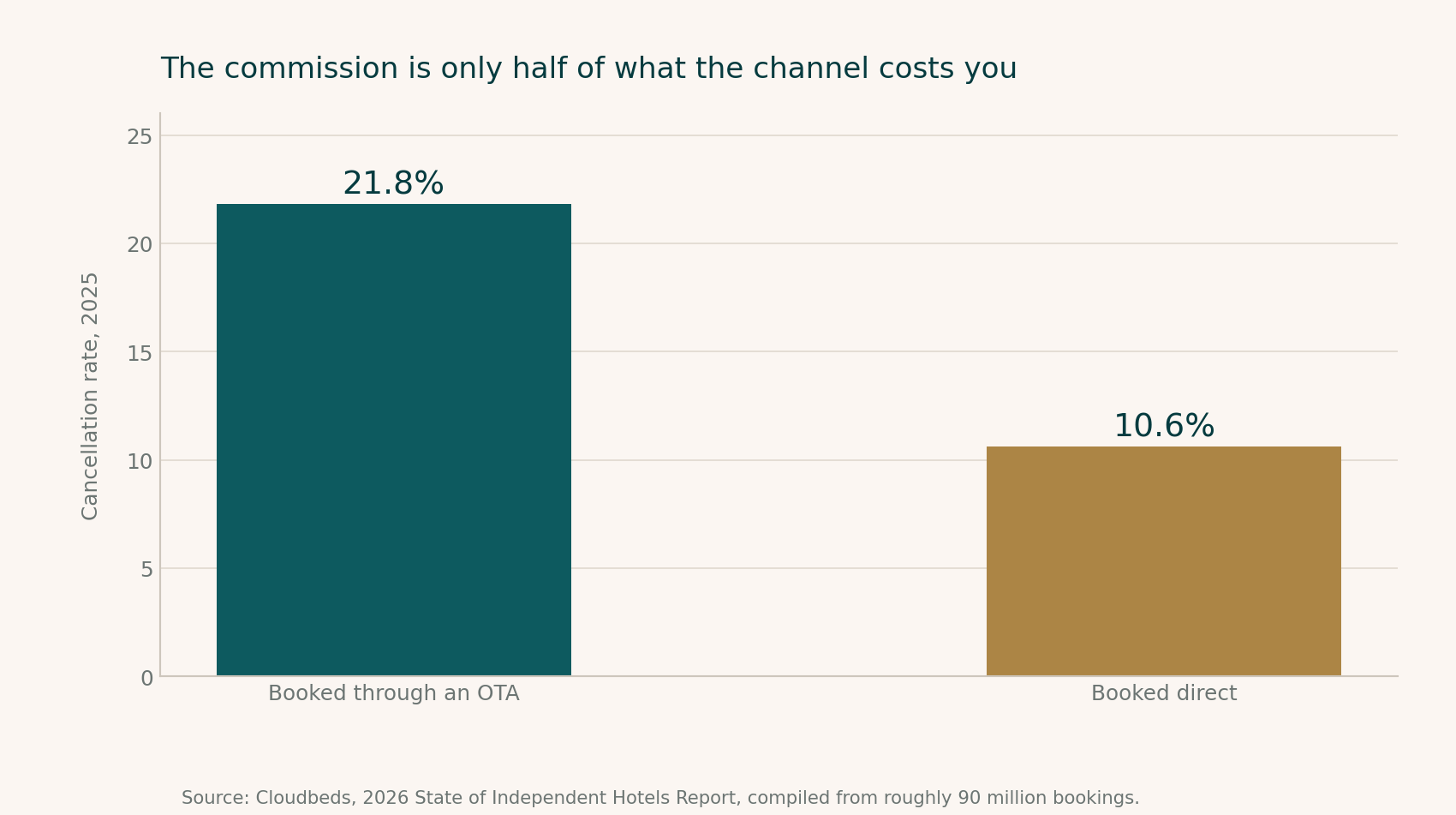
Here is what I did not understand until I had watched it on our own books for a few years. The commission is the visible cost. It is not the whole cost.
The same Cloudbeds data found that bookings made through an OTA cancelled at 21.8 percent in 2025, against 10.6 percent for direct bookings. Roughly double.
Source: Cloudbeds, 2026 State of Independent Hotels Report.
A cancellation is not a neutral event at a small property. It is a room you held, did not sell to someone else, and now have to resell inside a short window, often at a worse rate. At thirty rooms you do not have the inventory depth to absorb that the way a large box does.
Then there is the thing nobody puts a number on: the guest relationship. When the booking comes through a platform, the platform owns the email, the preferences, and the right to market to that person next year. You hosted them. Somebody else gets to invite them back.
Why "get off the OTAs" is bad advice
I want to be careful not to write the version of this argument that gets owners into trouble.
Those channels drive roughly 63 percent of independent bookings because they work. They produce reach that a single property cannot replicate, they fill nights that would otherwise sit empty, and they put you in front of travellers who have never heard of your building and never will through any channel you control.
Pulling your inventory is not a strategy, it is a tantrum, and the occupancy hit arrives faster than the commission savings.
The sensible target, as published benchmarks generally frame it, is a mix rather than an exit: moving toward something like 30 to 45 percent OTA, with the balance direct and negotiated, over a period measured in quarters rather than weeks.
The goal is not to stop paying for reach. It is to stop paying for reach on the guests who already know where you are.
What we are actually doing
Four things, none of them sophisticated.
Treating the property website as infrastructure rather than a brochure. If the booking path on your own site is worse than the booking path on a platform, you are not losing on commission, you are losing on product. That is fixable and it is on you.
Watching the mix as a number, every month. Channel share is the metric, not total bookings. If you are not measuring what proportion of your room nights came through each door, you cannot tell whether anything you did worked.
Going after the repeat guest specifically. The traveller discovering us for the first time through a platform is worth the commission. The one who stayed last spring and is coming back is not, and that is the booking worth moving.
Being realistic about what we can do at this size. We do not have a loyalty programme, a marketing department, or the budget to outbid anyone on branded search. What we have is a front desk that can ask a returning guest to book direct next time, and a rate we control. That is a smaller set of tools than a chain has, and it is not nothing.
The honest caveat
Every number above comes from published industry sources, linked below, and describes the independent segment broadly rather than any particular property. Commission terms vary enormously by platform, by market, by negotiated agreement, and by whether a property participates in sponsored placement. Our own channel mix and the terms we operate under are not published here and the figures in the illustration are not ours.
What I would say with confidence is this. If you own a small independent and you have never sat down and calculated what you paid in commission last year as a single number, do that this week. It is usually larger than people expect, and it is one of the few large numbers in this business that responds to attention.
This article reflects the personal views and operating experience of the author at the time of writing. It is general commentary, not legal, tax, accounting, financial, or investment advice, and it is not an offer or solicitation of any kind. External figures are drawn from the sources cited and were accurate as published. Market conditions, program rules, and regulations change, and we do not commit to updating anything published here. Confirm anything you intend to rely on with a qualified professional.
The Newsletter
Notes from the field, now and then
Occasional writing on the Southern California lodging market from inside two independent hotels. No schedule, no filler, and nothing sold to you.
We will not share your address, and you can leave at any time.
In July the SBA doubled how much a single borrower can hold across its two main programs. For owner operators buying independent hotels, this is the most consequential change to the capital stack in a generation.
Pasadena hands a small hotel one enormous compression event every January. The World Cup and Paris just confirmed what those Januaries taught me about what an event premium actually costs to collect.